Sorry, nothing in cart.
Why Choose Us!
- 5+ Lakh Customers Trust Us for Fast & Safe Delivery
- Secure Checkout – Your Data Stays 100% Private
- Express Delivery – No Waiting, No Delays
- Best Value For Money Guaranteed
- Get Premium Quality At Budget – Friendly Prices
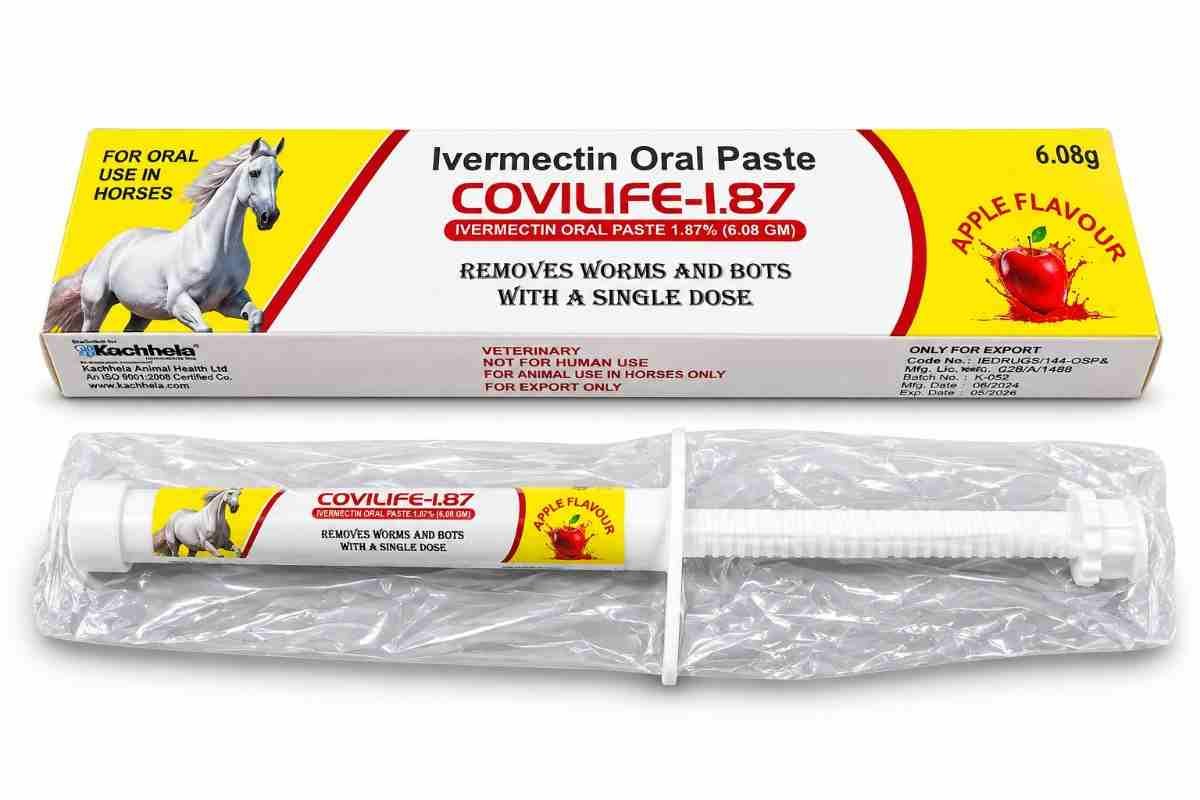
Covilife 1.87% Oral Paste for Horse (Ivermectin)
| 1.87% | 1 Paste, 3 Paste/s, 6 Paste/s |
|---|---|
| Active Ingredient: | Ivermectin |
| Indication: | Remove Worm and Bots in Horse |
| Manufacturer: | Kachhela Medex Pvt. Ltd. |
| Packaging: | 6.08 gm in 1 syringe |
| Strength: | 1.87% |
| Delivery Time: | 6 To 15 days |
| 1.87% |
1 Paste, 3 Paste/s, 6 Paste/s |
|---|---|
| Active Ingredient: |
Ivermectin |
| Indication: |
Remove Worm and Bots in Horse |
| Manufacturer: |
Kachhela Medex Pvt. Ltd. |
| Packaging: |
6.08 gm in 1 syringe |
| Strength: |
1.87% |
| Delivery Time: |
6 To 15 days |
20% OFF
Use coupon GPA20
Valid for order above AUD$499.00

|
|
||||||||||||||||||||||||

Description
Introduction
Covilife 1.87% Oral Paste for Horse contains ivermectin, an antiparasitic medicine used in veterinary care to manage susceptible parasites in horses. Ivermectin belongs to the macrocyclic lactone class of medicines and acts against particular parasitic worms and certain insect larvae. Appropriate parasite management is important for maintaining equine health and reducing the effects of parasitic infections.
This product is identified as an oral paste containing ivermectin at a concentration of 1.87%, intended for horses. Its suitability depends on the animal’s health, body weight, parasite exposure and previous treatment history. Veterinary guidance is important when selecting an antiparasitic treatment and planning an appropriate parasite control programme.
What Is It?
Covilife 1.87% Oral Paste is a veterinary antiparasitic preparation containing ivermectin. Ivermectin is an avermectin derivative belonging to the macrocyclic lactone family. It is used in veterinary medicine to control susceptible internal parasites and certain arthropods.
The preparation is intended for oral administration to horses. Ivermectin is not an antibiotic and does not treat bacterial or viral infections. It should not be used as a general treatment for unexplained weight loss, digestive problems or skin conditions without veterinary assessment.
Not every parasite is susceptible to ivermectin. The appropriate treatment depends on the parasite involved, its developmental stage and local resistance patterns.
How Does It Work?
Ivermectin acts on particular nerve and muscle functions in susceptible parasites. It binds selectively to glutamate-gated chloride channels found in invertebrate nerve and muscle cells. This increases chloride ion movement across cell membranes and disrupts normal nerve signalling.
The resulting paralysis prevents affected parasites from functioning normally and ultimately causes their death. Mammals do not possess the same glutamate-gated chloride channels, contributing to the selective antiparasitic action of ivermectin.
Its effectiveness depends on parasite susceptibility and developmental stage. Resistance can reduce treatment effectiveness, making appropriate veterinary assessment and monitoring important parts of parasite management.
Common Uses
Ivermectin is used in equine veterinary care against several groups of susceptible parasites. These include:
- Large strongyles: Certain intestinal worms, including susceptible Strongylus species.
- Small strongyles: Particular cyathostomin worms and susceptible larval stages.
- Roundworms: Certain ascarids, including Parascaris equorum.
- Pinworms: Susceptible stages of Oxyuris equi.
- Stomach bots: Certain oral and gastric larval stages of Gasterophilus species.
- Other parasites: Certain lungworms, intestinal threadworms, hairworms and neck threadworm microfilariae.
These are examples of parasite groups against which ivermectin has recognised veterinary activity. They do not establish that every species or developmental stage will respond to treatment. A veterinarian should assess the likely infection and determine whether ivermectin is appropriate.
Available Strengths
Key Features
- Active ingredient: Ivermectin.
- Concentration: 1.87% ivermectin.
- Dosage form: Oral paste.
- Intended animal: Horses.
- Medicine class: Macrocyclic lactone antiparasitic.
- Antiparasitic activity: Acts against susceptible worms and certain arthropod stages.
Benefits
- Parasite management: Ivermectin can help control susceptible internal parasites when appropriately selected.
- Multiple parasite targets: Its veterinary activity includes particular strongyles, roundworms, pinworms and bot larvae.
- Defined mechanism: It acts on parasite nerve and muscle function to produce paralysis and death.
- Oral administration: The paste form is intended to be administered by mouth.
- Veterinary programme support: It can be considered as part of a planned parasite control programme.
- Monitoring compatibility: Its effectiveness can be assessed through appropriate veterinary examinations and faecal testing.
These potential benefits depend on correct parasite identification, susceptibility and appropriate veterinary use. Treatment should be combined with responsible parasite monitoring rather than relying on repeated deworming without assessment.
Possible Side Effects
Horses may respond differently to ivermectin. Although serious reactions are not expected with appropriate use, owners should monitor animals following treatment.
- Swelling: Horses carrying heavy neck threadworm microfilarial infections may develop localised or more general swelling following treatment.
- Itching: Skin irritation may occur in association with the death of susceptible parasites.
- Temporary discomfort: Changes in behaviour or general condition should be assessed if they persist or become pronounced.
- Neurological effects: Excessive exposure can cause depression, impaired coordination, tremors, reduced responsiveness and severe neurological complications.
Swelling and itching may result from an inflammatory response to the death of large numbers of microfilariae. Contact a veterinarian if these reactions occur. Severe weakness, difficulty standing, tremors or marked behavioural changes require urgent veterinary attention.
Precautions
- Use the preparation only for horses and under appropriate veterinary guidance.
- Do not administer horse ivermectin preparations to dogs, cats or other animal species. Serious adverse reactions can occur in animals that ingest them.
- Discuss existing illnesses and nutritional problems with the veterinarian before treatment.
- Take particular care when treating sick or nutritionally compromised horses.
- Inform the veterinarian about previous reactions to ivermectin or other antiparasitic medicines.
- Do not use the medicine in an animal known to be hypersensitive to ivermectin.
- Monitor the horse following administration and report unexpected symptoms.
Additional Precautions
- Resistance management: Parasites can develop resistance to ivermectin. Unnecessary repeated treatment and underdosing can contribute to this problem.
- Veterinary assessment: Appropriate examinations and faecal testing can help establish treatment requirements and assess effectiveness.
- Other animals: Prevent dogs and cats from accessing spilled paste, used syringes or discarded packaging.
- Human safety: This is a veterinary preparation, not a human medicine. Keep it away from children and prevent accidental ingestion.
- Safe handling: Avoid contact with the eyes and skin. Wash hands after handling the preparation. Do not eat, drink or smoke while handling it.
- Environmental protection: Ivermectin residues excreted in manure can harm aquatic organisms. Prevent contamination of waterways and dispose of unused medicine appropriately.
- Food-producing animals: Follow applicable veterinary and regulatory requirements concerning animals intended for human consumption.
Storage Instructions
- Follow the storage temperature and handling instructions provided with the actual product.
- Keep the preparation securely stored and out of reach of children and animals.
- Protect the container from damage and conditions that could compromise its contents.
- Do not use the preparation if its container is damaged, leaking or appears to have been tampered with.
- Check the expiry date before use and do not use expired medicine.
- Dispose of unused medicine and packaging according to veterinary advice and applicable local requirements.
How to Take
- Veterinary advice: Confirm that ivermectin is appropriate for the horse and the suspected parasite before administration.
- Determine body weight: Establish the horse’s current weight as accurately as possible because administration is weight-dependent.
- Check instructions: Read the instructions accompanying the actual preparation and confirm its concentration and expiry date.
- Follow administration directions: Use the administration method and measuring mechanism specified for the supplied product.
- Ensure appropriate administration: The horse must receive the complete veterinarian-directed amount to avoid inadequate treatment.
- Monitor afterwards: Observe the animal for unexpected reactions and seek veterinary advice if symptoms develop.
The appropriate amount and treatment schedule must be established using the horse’s body weight and the instructions applicable to the actual preparation. Do not estimate an amount from the concentration alone or repeat treatment without veterinary guidance.
Drug Interactions
Ivermectin can interact with medicines that affect inhibitory neurotransmitter pathways. Veterinary product information identifies an increase in the effects of gamma-aminobutyric acid (GABA) agonists when used with ivermectin.
- Inform the veterinarian about all medicines and veterinary treatments the horse currently receives.
- Discuss sedatives and other medicines affecting the nervous system before combining treatments.
- Do not combine different deworming preparations without professional advice.
- Follow veterinary guidance when changing antiparasitic treatments.
- Report unusual sedation, impaired coordination or other unexpected changes after treatment.
The possibility of interactions should be assessed using the horse’s complete medication history. Do not assume that combining different antiparasitic preparations will improve treatment effectiveness.
Why Choose This Product?
- Identified active ingredient: Contains ivermectin at a stated concentration of 1.87%.
- Equine preparation: Presented as an oral paste intended for horses.
- Recognised antiparasitic ingredient: Ivermectin has an established veterinary role against several susceptible parasite groups.
- Defined action: Its effect on parasite nerve and muscle channels is well characterised.
- Planned parasite management: It can be considered within a veterinary-directed approach based on parasite exposure and susceptibility.
- Clear ingredient information: The stated active ingredient and concentration help veterinarians assess the preparation when considering treatment options.
Selecting an appropriate deworming medicine requires consideration of the horse’s health, parasite history, local resistance patterns and previous treatments. Veterinary guidance helps determine whether ivermectin is suitable and reduces unnecessary exposure to antiparasitic medicines.
Frequently Asked Questions (FAQs)
1. What is Covilife 1.87% Oral Paste used for?
It is an ivermectin-based veterinary preparation intended for horses. Ivermectin is used against susceptible parasitic worms and certain arthropod stages.
2. What is the active ingredient in Covilife?
The active ingredient is ivermectin, at a stated concentration of 1.87%.
3. How does ivermectin work in horses?
It affects particular chloride channels in parasite nerve and muscle cells, disrupting normal nerve activity and causing paralysis and death of susceptible parasites.
4. Does ivermectin work against every horse parasite?
No. Its activity depends on the parasite species and developmental stage. Resistance can also reduce effectiveness.
5. Can this preparation be given to dogs or cats?
No. Horse ivermectin preparations must not be given to dogs or cats because accidental ingestion can cause serious toxicity.
6. Can sick horses receive ivermectin?
Sick or nutritionally compromised horses require particular veterinary assessment before treatment. Their health and nutritional condition should be considered.
7. What side effects should horse owners monitor?
Watch for swelling, itching, unusual behaviour, weakness, impaired coordination or tremors. Serious or persistent symptoms require veterinary attention.
8. Can ivermectin resistance develop?
Yes. Parasites can develop resistance to ivermectin. Appropriate treatment selection, veterinary monitoring and faecal testing can help manage this risk.
9. How should the appropriate amount be determined?
Administration depends on the horse’s current body weight and the instructions for the actual preparation. A veterinarian should help establish the appropriate amount.
10. Can other medicines be used alongside ivermectin?
Some medicines, including GABA agonists, may interact with ivermectin. Inform the veterinarian about all current treatments before administration.
11. Is Covilife intended for human use?
No. It is a veterinary preparation intended for horses and must never be used as a human medicine.
12. How should Covilife be stored?
Follow the storage instructions accompanying the actual preparation. Keep it securely stored away from children and animals and do not use it after expiry.



Reviews
There are no reviews yet.